
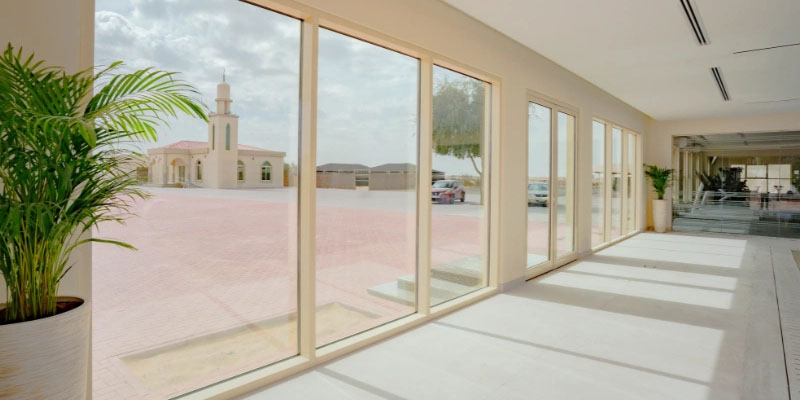
Glass can make an interior feel larger, brighter, and less visually divided, but selecting the right glass is an engineering decision as much as a design decision. For doors, partitions, shower enclosures, screens, and other applications where impact or thermal stress may occur, tempered glass can offer advantages over ordinary annealed glass. The key is choosing a specification that matches the application rather than assuming that every glass installation requires the same product.
Tempering Changes How Glass Behaves When It Breaks
Tempered glass is made using a heat treatment process to create a certain stress distribution inside the glass. Tempered glass becomes more resistant to mechanical and thermal stresses than an equivalent piece of annealed glass. The most important aspect of tempered glass in terms of its use indoors is that upon fracturing, the glass will normally break into small pieces instead of large, sharp ones like normal annealed glass would. That type of fracture characteristic is a part of the reason why heat-treated glass is used for safety glazing purposes.
Doors and Partitions Can Benefit From Safety Glazing
Think about a full-height glass door in a household, workplace, hotel, or commercial setting where there are many people moving about. In such scenarios, a person may fail to detect the glass object in the path and might get hurt upon contact. Glass that is near doors or is low on the floor is also susceptible to hazards. The Dubai municipal laws take into consideration safety issues regarding glazing in particular areas. Therefore, choosing the type of glass to use should depend on its application and not appearance.
Thermal Resistance Matters, But It Is Not the Whole Specification
Since Dubai has a very harsh environment in terms of weather, thermal resistance becomes an important factor to consider when choosing the glazing material, especially if the glass is subject to large fluctuations in temperature. Even though tempered glass is better than annealed glass in terms of thermal resistance, that doesn’t mean it is immune to thermal or mechanical failure. Design needs to take into account the factors of dimensions, support, edges, hardware, and loads involved. ASTM's specification specifically notes that the support system and glass deflection need to be considered during design.
Why Thickness Should Not Be Your Only Question
When comparing products at a glass shop Dubai, asking only whether a panel is 8 mm, 10 mm, or 12 mm is not enough to determine whether it is appropriate. The required specification depends on how the glass will be used, its dimensions, how it is supported, the hardware attached to it, and the loads it must withstand. A shower door, office partition, balustrade, and glass door can have very different design requirements even when they use visually similar panels.
Fabrication Must Be Planned Before Tempering
This is one crucial point that is often overlooked by most buyers. Tempered glass usually cannot be fabricated, cut, drilled, or even notched after the process of tempering has been done. According to ASTM, fabrications like cutting, edgework, drilling, notching, and grinding have to be done prior to the process of tempering or strengthening.
This implies that dimensions for hinges, handles, brackets, cutouts, and other similar things should be verified before producing tempered glass, since an incorrect dimension cannot be rectified later by cutting the glass panel.
Tempered Glass Supports Open Interior Designs
The appeal of glass in contemporary interiors is not only visual. Transparent partitions can separate spaces while maintaining sightlines and allowing light to pass between areas. Tempered glass can provide this design flexibility in applications where safety and resistance to everyday stresses are important. The result can be a partition, door, or enclosure that defines a space without creating the visual weight of a solid wall.
Choose Glass According to the Application
A reliable tempered glass Dubai supplier should first understand where and how the glass will be installed. Ask about the appropriate glass type, thickness, fabrication requirements, edge treatment, hardware compatibility, and applicable safety requirements. For projects governed by Dubai regulations, the supplier and designer should also verify the relevant code requirements rather than relying on a standard product recommendation. Dubai Municipality maintains building regulations and technical requirements for construction and glazing-related applications.
Make Safety and Design Work Together
Tempered glass is not automatically the right solution for every interior application. Its value comes from matching its properties to the conditions in which it will be used. When the glass specification, fabrication, support system, hardware, and installation method are properly coordinated, it can provide a practical combination of safety, durability, and visual openness. That makes tempered glass a useful material for modern Dubai interiors, not simply because it looks contemporary, but because its performance can be matched to specific design and safety requirements.
Now that you know why tempered glass is a practical choice for interiors, you can unhesitatingly choose it for your property. To get the best tempered glass for your property, call us now at +971 4 3324276.